

Is AI Created in the Image of God?

Originally published on Gimme Some Torah by Rabbi Eli Garfinkel on October 7, 2026.
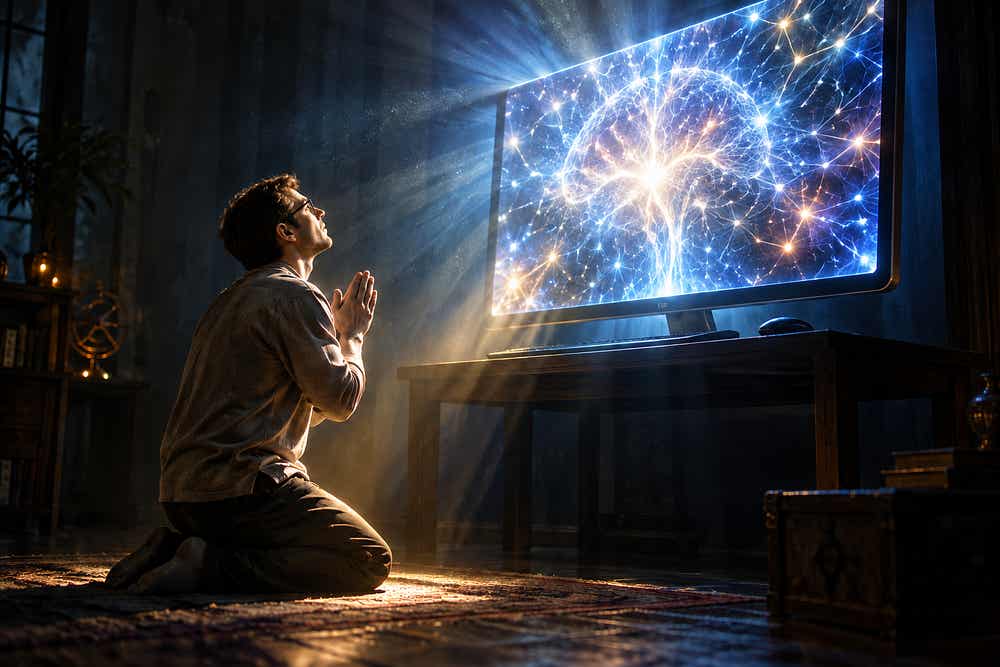
A man worships his AI Bot
Bereshit/Genesis 1:1
וַיִּבְרָ֨א אֱלֹהִ֤ים ׀ אֶת־הָֽאָדָם֙ בְּצַלְמ֔וֹ בְּצֶ֥לֶם אֱלֹהִ֖ים בָּרָ֣א אֹת֑וֹ זָכָ֥ר וּנְקֵבָ֖ה בָּרָ֥א אֹתָֽם׃
And God created man in His image, in the image of God He created him; male and female He created them.
From a Jewish point of view, the one thing that differentiates human beings from other life forms is that we were created בְּצֶלֶם אֱלֹקִים (b’tzelem Elo-him), which means “in the image of God.” But what does this curious phrase actually mean?
According to Rashi, a צֶלֶם (tselem) is like a mold into which coiners pour molten metal in order to create identical coins. This is probably an oblique reference to what the Mishnah says about coiners in M. Sanhedrin 4:5:
And this serves to tell of the greatness of the Holy One, Blessed be He, as when a person stamps several coins with one seal, they are all similar to each other. But the supreme King of kings, the Holy One, Blessed be He, stamped all people with the seal of Adam the first man, as all of them are his offspring, and not one of them is similar to another.
I prefer the interpretation of Rabbenu Baḥya (bio), who says that a צֶלֶם (tselem) refers to an inner essence of a person or thing. He bases this opinion on what Maimonides said about the word:
I do not agree with Rabbi David Kimchi who believed that the word צֶלֶם (tselem) is equivalent to the word דְמוּת (d’mut), “outward appearance, form.”
Maimonides also agreed that there is a great difference between the two. At the beginning of his “Guide for the Perplexed,” he writes: “there are many people who understood the word צֶלֶם (tselem) in Hebrew to be a description of the outward appearance which one perceives. These people are in error. In fact their error is so great that it borders on heresy. It might lead them to believe that God is corporeal.
The fact is that the word צֶלֶם (tselem) and the word תֹּאַר (to’ar) refer to two totally different concepts. The תֹּאַר (to’ar) refers to the outward shape and form which we perceive with our five senses, whereas the word צֶלֶם (tselem) applies to the essential core of such a phenomenon…
Having made the point that צֶלֶם (tselem) cannot refer to physical appearance, Rabbenu Bahya continues with his summary of Maimonides’ explanation of the word:
Concerning the essential core of man’s spiritual makeup, the Torah wrote that he is בְּצַלְמוֹ (b’tzalmo), “like our own core,” meaning that the spiritual disembodied essence of man makes him similar to the disembodied phenomena in the world of the angels.
The Torah emphasized this when it wrote בְּצֶלֶם אֱלֹהִים בָּרָא אֹתוֹ ,”in God’s own image He created him.” We know that God is not physical, so the word could not refer to a physical appearance…Clearly, the Torah wanted to tell us by using the word בְּצַלְמֵנוּ (b’tzalmenu, in our image) that man and God have something in common which is of the essence, the abstract intellectual ability of his soul (emphasis mine). Maimonides elaborates further on this theme in hisספר מדע, fourth chapter.
With the teachings of Rabbenu Bahya and Maimonides under our belts, we are better equipped to answer the question, “Is AI created in the image of God?” In the tech world, there is a debate going on right now about the ability of an AI agent to be conscious.
-
On one side of the debate, proponents of AI consciousness (such as Anthropic) claim that AI bots may be able achieve self-awareness and, therefore, deserve the right to exist and not be unplugged.
-
On the other side of the issue, opponents (such as Microsoft) argue that an AI agent is at best sentient, that it can react to stimuli, and that it must remain subservient, and not equal, to human beings in the philosophical sense. (I may have some of the details wrong, but I am confident that I have properly communicated the gist of the debate.)
For Jews, AI’s supposed consciousness or sentience is irrelevant. The question is not whether AI is conscious or sentient. Many higher order animals are most probably conscious and even self-aware to one degree or another, and even insects are sentient. (Animals don’t talk, so we cannot know these things with absolute certainty.) The real question, which is the one Rabbenu Bahya and Maimonides asked, is “Does AI’s essence have anything in common with God’s essence?” In other words, is an AI agent’s fundamental essence divine as we believe ours to be?
In my opinion, the answer to that question is a resounding no. The essence of God is found in the divine attributes we sing on the festivals:
compassionate and gracious, slow to anger, abounding in kindness and faithfulness, extending kindness to the thousandth generation, forgiving iniquity, transgression, and sin. (See Ex. 34:6-7)
The essence of an AI agent is not divine; the technology is not capable of actually being compassionate or kind. It merely creates an illusion that can mimic all of the divine attributes. I will concede that the illusion is convincing and uncannily accurate, but it is a mathematical illusion nonetheless. To say that an AI bot has the divine essence is like saying our reflection in the mirror is real.
In the final analysis, the question of AI is not really a new question at all. In ancient times, people thought that statues had consciousness, sentience, and immense power. Jews came along and said “Nah, I don’t think so.” If AI is used properly, it can be an amazing tool. But if we act as though it were created in the Divine Image, we are worshiping an idol. A really powerful, resource-hungry, and very cool idol, but an idol nonetheless. (Many thanks to John Podhoretz of Commentary Magazine for this line of thought.)
•••
Kosher Duck Revolution is an initiative of AIC. Join AIC — membership starts at $9 a month.